
The Problem Many Women Experience but Rarely Talk About
Today, modern treatments such as HIFEM Chair Treatment in Indore, HIFEM Chair treatment is helping women regain confidence, improve bladder control, and strengthen pelvic floor muscles without surgery.
The first step is understanding that you are not alone and that help is available.
It often begins with a small moment that feels too embarrassing to mention.
Maybe you laughed during a family function and noticed a few drops of urine leak unexpectedly.
Maybe it happened while sneezing.
Maybe while running after your child or climbing stairs.
At first, you ignore it.
You tell yourself:
“It’s probably because of childbirth.”
“Maybe this happens to all women after a certain age.”
“It’s not serious enough to talk about.”
So you stay silent.
Days turn into months. Months turn into years.
Without realizing it, you start changing your lifestyle. You avoid long journeys. You become cautious during exercise. You constantly look for washrooms when visiting new places.
What started as a minor inconvenience slowly begins affecting your confidence.
The reality is that thousands of women experience these symptoms every day. Yet very few discuss them openly because they feel embarrassed, uncomfortable, or simply assume it is a normal part of life.
At the clinic of Dr. Archana Mohana, many women arrive carrying these concerns silently. They are often surprised to learn that urinary leakage and pelvic floor weakness are common medical conditions that can be treated effectively.
Why Many Women Feel “Different” After Childbirth
Below are the reasons why HIFEM Chair Treatment in Indore has become increasingly popular among women who want to restore pelvic floor strength without surgery or lengthy recovery periods. Pregnancy is one of the most beautiful journeys in a woman’s life. However, it also brings significant changes to the body.
During pregnancy, the pelvic floor muscles support the growing weight of the baby for several months. These muscles work continuously to support the uterus, bladder, and bowel.
Then comes childbirth.
During a normal delivery, the pelvic floor stretches significantly to allow the baby to pass through the birth canal. While the body has an incredible ability to heal, recovery is not always complete for every woman.
Many women begin noticing subtle changes after delivery, Some feel that their bladder control is not the same as before.
Others notice urine leakage while coughing, sneezing, or laughing.
Some experience a sensation of heaviness in the pelvic region.
Many simply feel that their body has changed in ways they cannot fully explain.
Because motherhood comes with so many responsibilities, these symptoms are often pushed aside.
The baby’s needs come first.
Family responsibilities come first.
Personal health gets postponed.
Years later, many women finally decide to seek help when the symptoms start interfering with daily life.
“I Thought It Was Normal”
One of the most common statements Dr. Archana Mohana hears from patients is:
“I thought this was normal after delivery.”
This belief prevents many women from seeking treatment.
While certain physical changes after childbirth are common, persistent urinary leakage, pelvic floor weakness, and reduced muscle strength should not be ignored.
Imagine if someone developed knee pain after an injury and simply accepted it for the rest of their life without seeking treatment.
Understand the Pelvic Floor: The Hidden Support System
Many women have heard the term “pelvic floor” but are not exactly sure what it means.
The pelvic floor is a group of muscles located at the base of the pelvis. Think of these muscles as a hammock that supports important organs including the bladder, uterus, and bowel.
When these muscles are strong, they help:
- Control urination
- Support pelvic organs
- Maintain stability
- Improve core strength
- Support reproductive health
Signs That Your Pelvic Floor May Need Attention
Many women live with symptoms for years without realizing they may be related to pelvic floor weakness. Modern treatments such as HIFEM Chair Treatment in Indore are specifically designed to strengthen the muscles responsible for these functions.
Some common warning signs include:
Urine Leakage While Sneezing or Coughing
This is often one of the earliest signs.
A sudden increase in abdominal pressure causes small amounts of urine leakage.
Leakage During Exercise
Running, jumping, dancing, or gym workouts may trigger symptoms.
Frequent Urge to Urinate
Some women feel they need to visit the washroom more frequently than before.
Difficulty Controlling the Bladder
The ability to hold urine comfortably may gradually decrease.
Feeling of Pelvic Heaviness
Some women describe a sensation of pressure or heaviness in the pelvic area.
These symptoms can affect confidence and quality of life, but they do not have to be accepted as permanent.
Why Kegel Exercises Don’t Always Solve the Problem
When women search online for urinary leakage or pelvic floor weakness, they often find recommendations for Kegel exercises.
Kegels can certainly help some women.
However, there is one major problem.
Many women perform them incorrectly.
Studies have shown that a large number of women are unable to properly identify and activate their pelvic floor muscles.
Even when performed correctly, Kegel exercises require consistency and patience.
For busy mothers, working professionals, and women managing family responsibilities, maintaining a strict exercise routine can be challenging.
This is where many women begin looking for more effective options.
They want a solution that is safe, comfortable, and capable of strengthening muscles more efficiently.
This is exactly why treatments like HIFEM Chair Treatment in Indore are attracting so much attention today.
Instead of relying solely on voluntary muscle contractions, advanced technology helps activate the pelvic floor muscles at a much deeper level.
The Good News: You Don’t Have to Live With These Symptoms
Perhaps the most important message in this blog is this:
Urinary leakage, pelvic floor weakness, and reduced muscle strength are common, but they are not something you simply have to accept.
You do not need to plan your life around washrooms.
You do not need to stop exercising because of fear of leakage.
You do not need to feel embarrassed discussing these concerns.
Modern gynecology now offers safe, non-invasive options that can help improve pelvic floor health and restore confidence.
One such advancement is HIFEM Chair Treatment in Indore, which is helping many women regain control and improve their quality of life without surgery.
What Exactly Is HIFEM Chair Treatment?
By now, you may be wondering:
“If pelvic floor weakness is causing these problems, how can it be treated without surgery?”
This is where HIFEM technology comes into the picture.
HIFEM stands for High-Intensity Focused Electromagnetic Technology. It is an advanced treatment designed to strengthen pelvic floor muscles by creating powerful muscle contractions that are difficult to achieve through exercise alone.
What makes this treatment unique is its simplicity.
There are no injections.
No surgery.
No cuts.
No stitches.
No hospitalization.
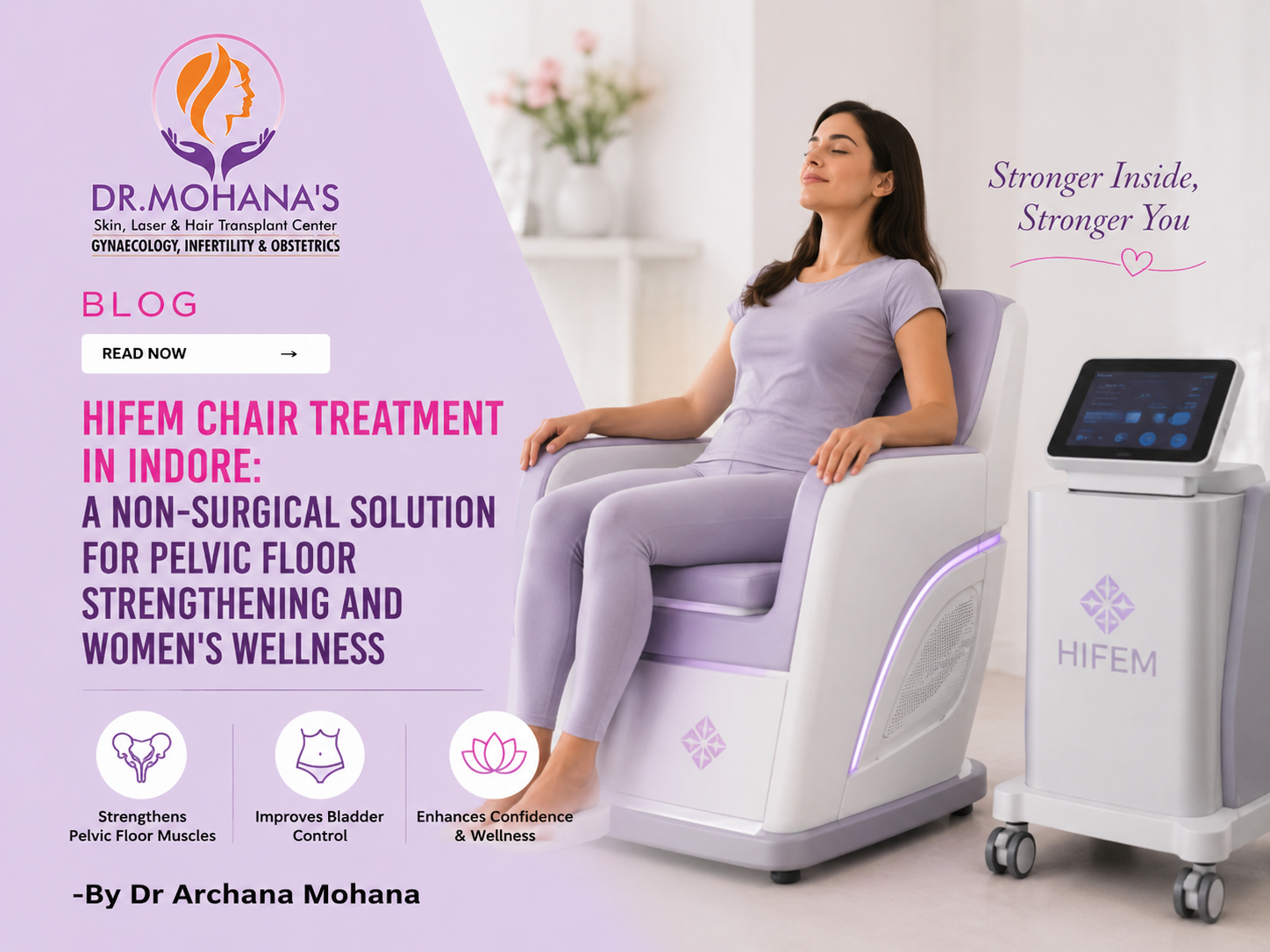
In fact, during the treatment, women simply sit comfortably on a specially designed chair while the technology works to strengthen the muscles deep inside the pelvic floor.
For many women, it almost sounds too good to be true.
But the science behind it is what makes it effective.
Imagine Doing Thousands of Kegel Exercises Without Any Effort
Let’s imagine something.
Suppose a doctor asked you to perform 10,000 Kegel exercises today.
Most people would laugh because it sounds impossible.
Even performing a few hundred correctly would be difficult.
Now imagine your pelvic floor muscles performing thousands of contractions automatically while you sit comfortably and relax.
That is essentially how HIFEM technology works.
The electromagnetic energy stimulates the muscles and creates what doctors call supramaximal contractions.
These contractions are much stronger and deeper than what most people can achieve voluntarily.
This is one of the reasons why HIFEM Chair Treatment in Indore has become such a popular option for women looking for non-surgical pelvic floor strengthening.
The treatment does the hard work while you remain comfortable.
Why Traditional Exercises Sometimes Fall Short
Many women genuinely try to improve their pelvic health through exercises.
They watch videos online.
They follow instructions from social media.
They read articles about Kegel exercises.
Yet after months of effort, they still notice urine leakage while sneezing, coughing, or exercising.
Why?
Because strengthening pelvic floor muscles is not always as simple as it sounds.
Some women activate the wrong muscles.
Some perform exercises inconsistently.
Others have muscle weakness that requires stronger stimulation than exercises alone can provide.
This is where HIFEM technology offers an advantage.
Instead of depending entirely on voluntary effort, the treatment directly targets and activates the muscles responsible for bladder support and pelvic stability.
The result is a level of muscle engagement that is difficult to achieve naturally.
Real-Life Situations Women Often Experience
When women visit Dr. Archana Mohana, they rarely begin the conversation by saying:
“I think I have pelvic floor weakness.”
Instead, they usually describe situations from everyday life.
For example:
“I Leak Urine When I Laugh”
Many women notice leakage during moments of laughter.
What should be a happy moment suddenly becomes stressful.
Some women even begin avoiding social situations because they worry about embarrassment.
“Sneezing Has Become a Problem”
A simple sneeze should not cause anxiety.
Yet many women find themselves crossing their legs or rushing to the washroom every time they feel a sneeze coming.
“I Stopped Going to the Gym”
Exercise is important for overall health.
Unfortunately, urinary leakage during workouts often discourages women from staying active.
Running, jumping, aerobics, and even simple exercises may trigger symptoms.
“After My Second Delivery, Everything Changed”
Childbirth is one of the most common causes of pelvic floor weakness.
Many women notice symptoms becoming more obvious after multiple pregnancies or deliveries.
“I Constantly Look for Washrooms”
Some women begin planning their entire day around restroom availability.
Road trips become stressful.
Shopping outings become shorter.
Even attending social events feels challenging.
If any of these situations sound familiar, you are not alone.
Thousands of women experience similar symptoms every day.
The good news is that solutions are available.
Why More Women Are Choosing HIFEM Chair Treatment
Modern women are busy.
Between work, family responsibilities, children, and personal commitments, most people do not have time for lengthy recovery periods.
This is one reason why HIFEM Chair Treatment in Indore is becoming increasingly popular.
Women appreciate the fact that:
The Treatment Is Non-Surgical
There are no incisions or stitches.
For many women, this immediately removes a major source of anxiety.
There Is No Downtime
One of the biggest advantages is convenience.
Most women can return to normal daily activities immediately after treatment.
No hospital admission is required.
No bed rest is necessary.
Sessions Are Quick
A typical treatment session usually lasts around 20–30 minutes.
Many women schedule appointments between work or household responsibilities.
The Procedure Is Comfortable
Most patients describe the sensation as muscle contractions rather than pain.
The treatment is generally well tolerated.
Results Continue to Improve
Unlike quick-fix solutions, HIFEM stimulates the body’s natural muscle strengthening process.
Improvements often continue developing over time as muscles become stronger and more coordinated.
More Than Physical Health: The Confidence Factor
One aspect of pelvic floor weakness that often gets overlooked is its emotional impact.
Many women silently carry feelings of embarrassment and frustration.
They worry about leakage during important events.
They avoid certain activities.
They become less confident in social situations.
Some women even stop participating in activities they once enjoyed.
“Main pehle morning walk ke liye jaati thi, lekin ab mujhe leakage ka darr rehta hai.”
This is something Dr. Archana Mohana hears frequently.
What begins as a physical symptom often affects emotional well-being as well.
That is why treatment is not only about strengthening muscles.
It is also about helping women regain confidence, freedom, and peace of mind.
Who Is an Ideal Candidate for HIFEM Chair Treatment?
HIFEM treatment may benefit women who:
- Experience urinary leakage
- Have pelvic floor weakness after childbirth
- Notice reduced bladder control
- Feel pelvic heaviness or weakness
- Want a non-surgical solution
- Are approaching or experiencing menopause
- Wish to improve pelvic floor strength proactively
However, every woman is different.
A proper evaluation is always necessary before deciding whether treatment is appropriate.
The First Step Is Often the Hardest
For many women, the most difficult part is not the treatment itself.
It is talking about the problem.
Years of embarrassment, hesitation, and misconceptions often prevent women from seeking help.
Yet the moment they finally discuss their symptoms, many realize something important:
“I should have asked for help much earlier.”
Pelvic floor weakness is common.
Urinary leakage is common.
Post-childbirth changes are common.
But suffering in silence should not be common.
Modern treatments such as HIFEM Chair Treatment in Indore are helping women take control of their health in a safe, comfortable, and effective way.
What Happens During a HIFEM Chair Treatment Session?
One of the biggest reasons women hesitate to seek treatment is uncertainty. They often imagine complicated procedures, pain, or long recovery periods.
The reality is very different.
A HIFEM Chair session is designed to be simple, comfortable, and stress-free.
The process begins with a consultation with Dr. Archana Mohana. During this discussion, she carefully understands your symptoms, medical history, lifestyle, and treatment goals.
Many women feel relieved during this consultation because it is often the first time they openly discuss concerns that they have been carrying for months or even years.
Once the treatment plan is finalized, the session itself is straightforward.
The patient remains fully clothed and sits comfortably on the HIFEM Chair. The chair then delivers electromagnetic energy that stimulates the pelvic floor muscles.
During the session, most women feel rhythmic muscle contractions. Some compare it to an intense workout happening inside the body while they simply sit and relax.
The treatment usually takes around 20 to 30 minutes.
After the session, women can immediately return to their daily activities, work, household responsibilities, or social engagements.
There is no downtime, no hospital stay, and no interruption to normal life.
How Many Sessions Are Usually Required?
Every woman is different.
Some women seek treatment for mild urinary leakage, while others have experienced symptoms for many years. The severity of pelvic floor weakness, childbirth history, age, and overall muscle condition all influence the treatment plan.
Most women require a series of sessions to achieve optimal results.
Dr. Archana Mohana creates a personalized treatment plan based on individual needs rather than following a one-size-fits-all approach.
Many women begin noticing improvements gradually.
Some notice better bladder control after a few sessions.
Others observe increased pelvic strength and confidence over the following weeks.
The important thing to remember is that muscle strengthening is a process. Just like building strength in the gym takes time, strengthening the pelvic floor also requires consistency.
What Improvements Do Women Commonly Notice?
One of the most rewarding aspects of treatment is hearing women describe how their daily lives have changed afterward.
The improvements often go beyond physical symptoms.
Many women report:
Better Bladder Control
Activities that previously caused leakage become easier to manage.
Laughing, coughing, and sneezing no longer create the same level of anxiety.
Increased Pelvic Strength
Women often describe feeling stronger and more supported internally.
Simple daily activities become more comfortable.
Greater Confidence
Confidence is something that many women do not realize they have lost until they regain it.
The fear of embarrassment gradually decreases, allowing them to enjoy social situations more freely.
Improved Quality of Life
Many women begin exercising again.
Some return to activities they had previously avoided.
Others simply enjoy the peace of mind that comes from knowing they have better control over their bodies.
One patient described it beautifully:
“For the first time in years, I stopped thinking about where the nearest washroom was.”
That small change can have a huge impact on daily life.
Why Ignoring Pelvic Floor Weakness Is Not a Good Idea
Many women spend years hoping symptoms will improve on their own.
Unfortunately, pelvic floor weakness often becomes more noticeable over time if left untreated.
What starts as occasional leakage during sneezing may gradually become more frequent.
Daily activities can become increasingly uncomfortable.
Confidence may continue to decline.
Most importantly, delaying treatment often means living with unnecessary frustration for much longer than necessary.
“Jitni jaldi problem ko samjha aur address kiya jaye, utne hi better results mil sakte hain.”
Seeking medical advice early allows women to explore effective options before symptoms begin affecting multiple aspects of life.
Simple Lifestyle Habits That Support Pelvic Floor Health
While HIFEM Chair Treatment in Indore can be highly effective, healthy lifestyle habits also play an important role in long-term pelvic health.
Maintain a Healthy Weight
Excess weight places additional pressure on pelvic floor muscles. Maintaining a healthy weight can reduce strain and support better muscle function.
Stay Physically Active
Regular movement helps maintain muscle strength throughout the body, including the pelvic region.
Drink Enough Water
Some women reduce water intake to avoid urinary leakage. However, proper hydration remains important for bladder health.
Manage Constipation
Frequent straining during bowel movements can place additional stress on pelvic floor muscles.
Follow Medical Advice
Every woman’s body is unique. Following personalized recommendations from your doctor helps achieve the best outcomes.
Combining healthy habits with professional treatment often provides the most effective long-term results.
Frequently Asked Questions (FAQs)
Is HIFEM Chair Treatment painful?
No. Most women describe the treatment as comfortable. They usually feel muscle contractions during the session, but the procedure is generally well tolerated.
Can HIFEM Chair Treatment help with urinary leakage?
Yes. The treatment is designed to strengthen pelvic floor muscles, which can help improve bladder control and reduce urinary leakage in many women.
How long does one session take?
Most HIFEM Chair sessions take approximately 20 to 30 minutes, making it convenient even for women with busy schedules.
Is there any recovery time after treatment?
No. Women can usually return to their normal daily activities immediately after the session without any downtime.
Who should consider HIFEM Chair Treatment?
Women experiencing urinary leakage, pelvic floor weakness, post-childbirth changes, or reduced bladder control may benefit from a professional evaluation to determine if the treatment is suitable for them.